Resumen del artículo
Elegir el soporte de arco adecuado para la fascitis plantar significa mirar más allá de la amortiguación. Whether you are recovering from plantar fasciitis or learning how to prevent plantar fasciitis from developing in the first place, the features below are what separate effective arch supports from generic insoles.
- Generic foam inserts cushion the foot temporarily but do not address the alignment and pressure issues behind plantar fasciitis.
- Effective arch supports provide structured support for all four arches, a deep heel cup for stability, and materials built to hold their shape under body weight rather than compress over time.
- Lateral stability, metatarsal support, and shock absorption work together to reduce strain on the plantar fascia throughout the day.
- Because every foot is different, a personalized fitting matched to your specific arch height, foot shape, and daily demands produces more consistent relief than an off-the-shelf product.
Plantar fasciitis is one of the most common causes of heel pain, affecting roughly 1 in 10 people at some point in their lives (Cleveland Clinic). If you are dealing with it now, or looking for how to prevent plantar fasciitis from coming back after recovery, the arch support you choose matters more than most people realize.
Not all arch supports are the same. Generic drugstore insoles cushion the foot, but they do not address the alignment and pressure distribution issues that cause plantar fasciitis to develop or return. The difference between a product that helps and one that does not often comes down to a specific set of structural features. This guide walks through the 10 that matter most
¿Qué es la fascitis plantar?
La fascitis plantar es una inflamación de la fascia, la banda de tejido conectivo grueso que recorre la planta del pie desde el hueso del talón hasta cada uno de los cinco dedos. Es una de las causas más comunes de dolor de talón y afecta a una de cada diez personas en algún momento de su vida. Si bien el dolor suele disminuir al levantarse y moverse, estar parado o sentado por períodos largos puede agravar el problema y crear un ciclo frustrante de alivio y molestia.
Entender qué causa la fascitis plantar ayuda a explicar por qué ciertas características específicas de los soportes de arco son tan importantes para el alivio.
Risk Factors and How to Prevent Plantar Fasciitis
Several factors increase the likelihood of developing plantar fasciitis. Understanding them is the first step toward prevention.
Unsupportive footwear. Shoes that lack arch support increase strain on the plantar fascia with every step. Wearing supportive footwear consistently, and using arch supports designed to hold their shape, is one of the simplest preventive steps.
Prolonged standing or walking on hard surfaces. Retail, healthcare, teaching, manufacturing, and other professions that keep you on your feet for hours place sustained stress on the plantar fascia.
Age and activity level. Plantar fasciitis most commonly develops between ages 45 and 65, though it can affect people younger and older. Both high-impact exercise and prolonged inactivity increase risk.
Biomechanical factors. Flat feet, high arches, tight calf muscles, and a tendency to overpronate all change how force moves through the foot and can increase strain on the fascia.
Body weight. A systematic review of plantar fasciitis research identified BMI as one of the most consistent risk factors across the literature (Rhim et al., Life, 2021). More weight means more load on the plantar fascia with every step.
Cómo los soportes de arco ayudan a la fascitis plantar
When the plantar fascia is repeatedly strained through poor alignment, unsupportive footwear, or excessive impact, it can develop the microtears and inflammation that produce plantar fasciitis pain. Arch supports address this by changing how the foot distributes pressure during standing and walking.
Research supports this mechanism. A 2020 study published in PLOS ONE found that arch support improved stance time, step cadence, plantar pressure distribution, and contact area in adults with flat feet across multiple walking conditions (Huang et al., 2020). In practical terms, the right support under the arch changes how the foot handles each step, distributing pressure more evenly rather than concentrating it under the collapsed midfoot or the heel.
Rather than simply cushioning your foot, effective arch supports work to improve alignment, redistribute pressure evenly, reduce excessive motion that strains the fascia, and support proper gait mechanics from the ground up. The 10 features below are what separate arch supports that provide this kind of functional benefit from generic insoles that cushion without correcting.
10 características a tener en cuenta en los soportes de arco para la fascitis plantar
1. Structured Support, Not Just Cushioning
The most common mistake people make when choosing arch supports for plantar fasciitis is assuming softer means better. Foam insoles cushion impact, but they do not hold the foot in a supported position. Once the material compresses under body weight, the foot returns to the same alignment that caused the problem.
Effective arch supports use semi-rigid polymers that hold their shape under body weight, maintaining the foot's position throughout the full stride rather than collapsing under pressure. This structural integrity is what allows the support to reduce strain on the plantar fascia over thousands of steps a day, not just the first few. Over-the-counter gel or foam inserts may feel comfortable initially because they cushion impact, but they lack the structural support needed to maintain arch height or stabilize the heel. Within months, these materials compress and lose what little support they provided.
2. Soporte para los cuatro arcos del pie
Your foot has four distinct arches, not one, and they work together as a system. Most generic insoles address only the inner longitudinal arch, leaving the other three unsupported. When one arch is supported and the others are not, the unsupported arches compensate by working harder, which can create new strain patterns.
The Inner Longitudinal Arch runs from the ball of the foot to the heel and is unique in length and height to each individual. This arch controls inward and outward foot rotation (pronation and supination). When it collapses or goes unsupported, your foot rolls inward with each step, stretching the plantar fascia beyond its normal range and causing inflammation.
The Outer Longitudinal Arch absorbs the natural roll of the foot during walking, functioning as a shock absorber for your entire lower body. Este arco reduce la tensión en los tobillos, rodillas y caderas al distribuir las fuerzas de impacto. Without proper support here, your outer foot edge takes excessive pressure, forcing other structures, including the plantar fascia, to compensate.
The Transverse Arch forms a dome-like structure across the midfoot, providing balance and stability and acting as the foundation for the other arches. When this arch collapses, it creates a chain reaction affecting the entire foot structure. Many people with plantar fasciitis have weakness in this area without realizing it.
The Metatarsal Arch spreads across the ball of the foot and helps distribute pressure during the push-off phase of walking. Proper metatarsal support prevents excessive pressure from concentrating in the heel and arch, distributing body weight more evenly across the entire foot.
All four arches work together as a connected system. When arch supports only address one or two, the unsupported arches compensate by working harder, often leading to new pain patterns. The best arch supports for plantar fasciitis honor this by supporting the entire foot structure, not just the most obvious arch.
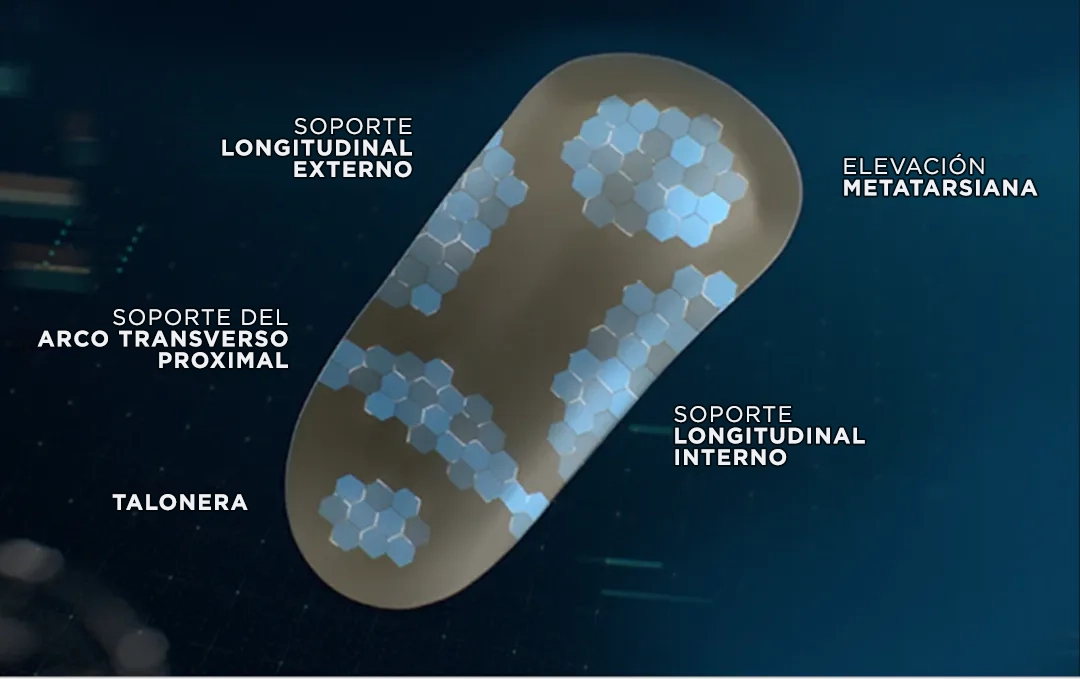
3. Diseño adecuado de la talonera para brindar estabilidad y amortiguación
A deep, contoured heel cup cradles the heel bone and prevents it from shifting side to side with each step. Without proper heel containment, the plantar fascia stretches unevenly at its attachment point on the heel, which is exactly where most plantar fasciitis pain concentrates.
An effective heel cup is deep enough to fully surround the heel on the bottom and sides, anatomically contoured to create even contact and pressure distribution, and firm enough to provide structure while incorporating cushioning to absorb the impact of heel strike. The heel cup works together with the arch support to maintain proper foot positioning throughout the entire gait cycle, from heel strike through midstance to toe-off. This comprehensive support through each step is what separates a well-designed arch support from a simple cushioning insert.
4. Amortiguación y gestión estratégica de los impactos
Si bien la estructura y el soporte son fundamentales, la amortiguación estratégica tiene un papel importante en el alivio de la fascitis plantar. The key word is "strategic." Cushioning must be placed intentionally to absorb impact without compromising the structural support your foot needs.
Too much cushioning creates instability and allows the foot to sink out of alignment. Too little means every step sends jarring forces into an already inflamed plantar fascia. The ideal approach uses multi-density materials that provide targeted cushioning in high-impact areas (primarily the heel and forefoot) while maintaining firm, structured support through the arch. This combination absorbs shock where you need it while keeping your foot in the alignment that reduces strain on the fascia.
The appropriate cushioning level depends on your activities, body weight, and stage of recovery. Higher-impact activities benefit from enhanced cushioning, while lighter activities may need less. This is one reason why a system approach, with different supports for different activities, makes sense for many people with plantar fasciitis.
5. Posicionamiento biomecánicamente correcto de los pies
An arch support should hold the foot in neutral alignment, where the foot is not rolling excessively inward (overpronation) or outward (supination) and weight is distributed evenly from heel to toe. This neutral position allows the plantar fascia to bear normal loads without excessive stretching.
Overpronation is one of the most common contributors to plantar fasciitis. When your foot rolls inward, the arch collapses and stretches the plantar fascia beyond its normal range with every step. Las personas con pies planos o el arco bajo suelen sobrepronar sin darse cuenta. Supination is less common but equally problematic, concentrating impact forces on the outer edge of the foot and heel.
Your feet are the foundation for the rest of your body. When they are misaligned, the problem moves upward through the ankles, knees, hips, and lower back. Many people with plantar fasciitis also experience discomfort in these areas, all connected to how the foot meets the ground. The arch support's contour needs to match your individual arch height and length, since too much support can create pressure points and too little fails to correct the alignment issues that strain the fascia. This is one of the strongest arguments for a personalized fitting rather than guessing from a shelf.
6. Estabilidad de lado a lado para las actividades diarias
Your foot does not just move forward and backward. It shifts side to side constantly during walking and standing, adjusting to maintain balance. When arch supports lack lateral stability, the plantar fascia has to work harder to stabilize the foot with each step, adding strain on top of the load it is already bearing.
Los soportes de arco de Good Feet proporcionan soporte longitudinal interno y externo, lo cual es ideal para el alivio de la fascitis plantar. The inner longitudinal support prevents excessive inward rolling, while the outer longitudinal support prevents the foot from collapsing outward. Juntos, estos soportes crean una plataforma estable que controla el movimiento sin restringir la flexibilidad natural que necesita el pie. This stability is especially important for people who spend long hours on their feet or work on hard surfaces, where the cumulative effect of thousands of slightly unstable steps adds up throughout the day.
7. Soporte Metatarsal y Distribución Equilibrada de la Presión
Excessive pressure on the ball of the foot directly contributes to plantar fasciitis pain. The plantar fascia connects the heel to the toes, so concentrated pressure on the forefoot pulls the fascia forward and increases tension along its entire length. This explains why some people experience both heel and ball-of-foot pain simultaneously.
A metatarsal pad built into the arch support lifts the metatarsal bones slightly and redistributes pressure more evenly across the forefoot. Think of it like balancing a seesaw: when too much weight concentrates at the front, it pulls on the fascia from one end while body weight pushes down at the other. Metatarsal support reduces that stretching force, allowing the fascia to function in a less strained position. When arch supports provide comprehensive pressure distribution, supporting the heel, arches, and metatarsal region together, they reduce concentrated stress on the plantar fascia from multiple angles simultaneously.
8. Versatilidad a Través de Diferentes Estilos de Calzado
If arch supports only fit in one pair of shoes, you will not wear them consistently, and consistency is what produces results. The best arch supports for plantar fasciitis work across athletic shoes, work shoes, casual footwear, and boots without creating a cramped fit or losing their structural benefit.
This versatility matters because plantar fasciitis does not take a break when you change shoes. If your feet are supported during a morning run but unsupported during an afternoon at work, the strain accumulates in the unsupported hours. Many shoes come with basic factory insoles that should be removed before adding arch supports, since they provide minimal benefit and take up space better used by your structured supports. When evaluating arch supports, bring the types of shoes you wear most often so you can confirm compatibility and proper fit.
9. Personalized Fitting and Selection
Arch supports work best when they are matched to the individual foot rather than designed for an average one. Arch height, foot width, pronation patterns, and daily activity demands all vary from person to person, and what works well for one foot may not work for another. Research supports this: a 2020 study in the Journal of Foot and Ankle Research found that preference for arch support firmness and height varied significantly between individuals (Williams, Nester, and Anderson, 2020).
At The Good Feet Store, a trained Arch Support Specialist spends up to an hour getting to know you and your feet. This includes detailed foot mapping and measurement of all four arches, observation of how you stand and walk to identify pronation or supination patterns, discussion of your daily demands, activity level, and preferred footwear, and a test-walk with multiple options so you can feel how each affects your comfort and balance. With 400+ combinations of styles, flexibilities, and sizes, Good Feet Arch Supports are fitted to work with your specific foot structure rather than forcing your foot to adapt to a generic design.
10. Un Enfoque Progresivo del Sistema para el Alivio a Largo Plazo
A single arch support may not provide the right level of support for every part of your day. The demands on your feet during a morning workout, an eight-hour shift, and an evening at home are different, and matching the support level to the activity tends to produce better results than a one-size-fits-all approach.
The Good Feet Store's 3-Step System is designed around this idea. It includes three personally fitted arch supports that work together across your day:
Strengthener supports provide firm, structured support for high-impact activities, extended standing, and times when your symptoms are most active. Use them for work, vigorous exercise, long walks, or any activity where your feet take significant stress.
Los Soportes para Maintainers brindan un soporte moderado para las actividades cotidianas y el desgaste general. These are your all-purpose supports, appropriate for casual walking, errands, light exercise, and typical daily routines.
Los Soportes de Relajación ofrecen un apoyo más ligero para actividades de bajo impacto y períodos de recuperación. These allow your foot muscles to work and strengthen while still maintaining alignment and preventing the arch collapse that aggravates plantar fasciitis.
When worn together as a system across your various activities, Good Feet Arch Supports are designed to help improve the biomechanics that often contribute to plantar fasciitis and may help reduce foot, knee, hip, and back discomfort.
Comparación rápida: soportes de arco vs. Ortesis personalizadas vs. Plantillas por correo
Característica | Buen soporte del arco de los pies | Plantillas ortopédicas personalizadas (podólogo) | Plantillas "personalizadas" por pedido por correo |
|---|---|---|---|
Coste | $399-$599 por par; garantía limitada de por vida incluida | $300-$800+ por par, más varios costos de consulta | $50-$200, pero puede requerir recompras |
Disponibilidad el mismo día | Sí, salga con ellos | No, el tiempo de respuesta en el laboratorio tarda semanas | No, espere el envío |
Se requiere visita médica | No | Sí, varias citas son típicas | No |
Ajuste personalizado | Sí, ajuste especializado en tienda | Sí, molde y receta del podólogo | Limitado: kit de impresión, no análisis de la marcha |
Aborda la causa raíz | Sí, el sistema de 3 pasos trabaja para fortalecer y apoyar | Sí, cuando se prescribe correctamente | Puede que encaje con la forma del pie, no con el problema biomecánico |
Durabilidad / Vida útil | Duradero; dura mucho más que las plantillas genéricas | Duradero, pero costoso de reemplazar | Varía; a menudo una vida útil más corta |
Questions About Arch Supports for Plantar Fasciitis
How can I prevent plantar fasciitis from coming back?
Preventing plantar fasciitis from returning comes down to consistency with the habits that helped it heal: supportive footwear, regular stretching, and arch support that holds the foot in proper alignment during daily activity. Keeping up with these habits after the pain resolves is more effective than restarting them after a flare-up.
Do arch supports actually help with plantar fasciitis?
Research shows that arch supports can change how the foot distributes pressure and absorbs impact during walking, which reduces strain on the plantar fascia. A 2020 study in PLOS ONE found that arch support improved stance time, cadence, and pressure distribution in adults with flat feet (Huang et al., 2020). The benefit depends on the fit and support level matching your individual foot, which is why personalized fitting tends to produce better outcomes than off-the-shelf products.
Fuentes
Cleveland Clinic. Plantar Fasciitis.
Huang, Y. P., et al. (2020). The arch support insoles show benefits to people with flatfoot. PLOS ONE, 15(8), e0237382.
Rhim, H. C., et al. (2021). A systematic review of systematic reviews on the epidemiology, evaluation, and treatment of plantar fasciitis. Life, 11(12), 1287.
Williams, C. M., Nester, C., & Anderson, J. (2020). Preference for arch support firmness and height. Journal of Foot and Ankle Research.
La información de este artículo es solo para fines educativos generales y no está destinada a ser un consejo médico. Los especialistas en soporte del arco de Buenos Pies no son profesionales sanitarios titulados y no diagnostican condiciones ni prescriben tratamientos. Si usted tiene diabetes, neuropatía, trastornos circulatorios, úlceras en el pie o ha tenido una cirugía reciente en el pie, consulte a un profesional sanitario titulado antes de utilizar soportes de arco.